
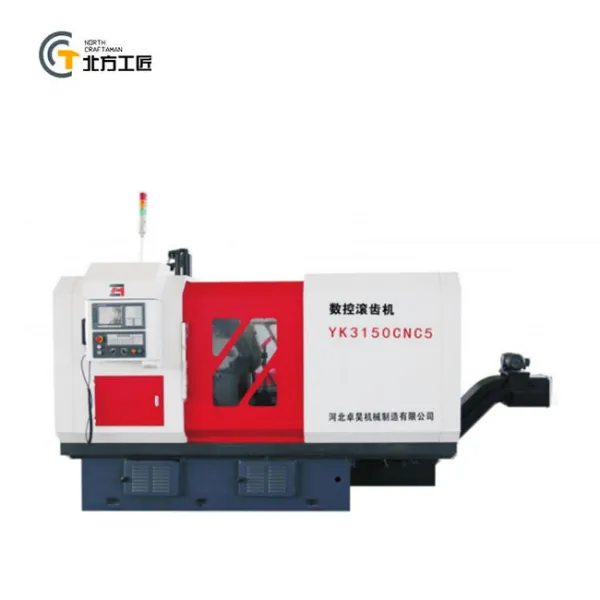
A high precision CNC Gear Hobbing Machine** is one of the most important pieces of equipment in modern automotive gear manufacturing. As the automotive industry continues to demand higher efficiency, lower noise, greater durability, and tighter tolerances, gear production technology must also advance. Among the many machine tools used in gear cutting, the CNC Gear hobbing machine stands out for its accuracy, flexibility, productivity, and suitability for mass production. It is widely used to manufacture automotive gears such as spur gears, helical gears, worm gears, splined shafts, and other transmission components.
1. Introduction to Gear Hobbing
Gear hobbing is a machining process in which a rotating cutting tool called a hob progressively cuts teeth into a workpiece. The hob and the workpiece rotate in a synchronized relationship, allowing the tooth profile to be generated accurately. This method is especially effective for producing gears with consistent tooth geometry and excellent repeatability.
In the automotive sector, gears are critical components in transmissions, differentials, steering systems, and engine timing systems. These gears must operate under high loads, high speeds, and continuous friction. Therefore, the quality of gear tooth surfaces and the accuracy of tooth shape directly affect vehicle performance, fuel efficiency, and service life. A high precision CNC gear hobbing machine is designed to meet these strict requirements.
2. Why CNC Technology Matters
Traditional gear hobbing machines relied heavily on mechanical settings and operator skill. Although they could produce gears effectively, they lacked the flexibility and automation required by modern manufacturing. CNC technology has transformed the process by introducing digital control, automation, and high repeatability.
A CNC gear hobbing machine uses a computerized control system to manage the motion of the hob, the workpiece, feed rates, spindle speed, and cutting depth. This enables the machine to produce complex gear forms with very high accuracy. Once the parameters are programmed, the same gear can be produced repeatedly with minimal variation. This is especially valuable in automotive production, where large batches of identical parts are required.
CNC systems also reduce human error. Operators no longer need to rely on manual adjustments for every job. Instead, they can store machining programs, quickly switch between different gear types, and optimize cutting conditions based on material and design specifications. This improves productivity while maintaining precision.
3. Key Features of High Precision CNC Gear Hobbing Machines
A high precision cnc gear hobbing machine for automotive gears usually includes several advanced features:
High rigidity structure:
The machine bed and main frame are built from heavy-duty cast iron or other vibration-resistant materials. This helps reduce chatter during cutting and ensures stable machining accuracy.
Multi-axis CNC control:
Modern machines often use multiple synchronized axes to control the hob, workpiece, and feed movements. This allows the machine to cut gears with complex geometries and precise tooth alignment.
Servo-driven motion system:
High-performance servo motors provide accurate and smooth movement. They improve response speed, positioning accuracy, and synchronization between the hob and the workpiece.
Automatic loading and unloading:
For mass production, automated part handling systems can significantly improve efficiency and reduce labor costs.
Thermal stability and compensation:
During long machining operations, heat can affect dimensional accuracy. Advanced machines may include thermal compensation systems to maintain consistent performance.
High-speed spindle and cutting capability:
Automotive gear production often requires both speed and precision. A high-speed hob spindle allows efficient material removal while preserving surface quality.
Digital monitoring and diagnostics:
Modern CNC machines can monitor tool wear, spindle load, cutting conditions, and machine status in real time. This helps prevent errors and supports predictive maintenance.
4. Advantages for Automotive Gear Manufacturing
The automotive industry is highly competitive, and manufacturers need equipment that can deliver quality, speed, and cost efficiency. High precision CNC gear hobbing machines offer several important advantages.
Excellent dimensional accuracy:
Automotive gears must meet strict standards for pitch, profile, lead, and concentricity. CNC gear hobbing machines can achieve tight tolerances and consistent tooth accuracy.
High repeatability:
In mass production, every part must match the same specification. CNC control ensures that each gear produced is nearly identical to the previous one.
Improved surface finish:
A precise cutting process reduces the need for secondary finishing operations and helps achieve smoother tooth surfaces, which lowers friction and noise in vehicle operation.
Greater productivity:
Automation, fast setup, and optimized cutting parameters allow manufacturers to produce more gears in less time.
Flexible production:
The same machine can produce different gear sizes and types by changing the program and tooling. This is ideal for manufacturers that supply multiple automotive models.
Reduced waste and cost:
Higher accuracy means fewer defective parts and less material waste. Over time, this lowers overall production cost.
5. Applications in Automotive Gears
High precision CNC gear hobbing machines are used to produce many types of automotive gears, including:
- Transmission gears
- Differential gears
- Timing gears
- Steering system gears
- Pump gears
- Splined shafts
- Helical gears for quiet operation
- Spur gears for power transmission
These components are used in passenger cars, commercial vehicles, electric vehicles, and hybrid systems. As electric vehicles become more popular, gear precision becomes even more important because electric drivetrains often operate at higher speeds and require quieter, more efficient gear systems.
6. Material Compatibility
Automotive gears are commonly made from alloy steels, carbon steels, case-hardened steels, and other high-strength materials. High precision CNC gear hobbing machines are designed to handle these materials efficiently. With the right hob material and cutting parameters, the machine can process hardened or semi-hardened blanks and produce gears ready for heat treatment or final finishing.
Material selection is crucial because the cutting process must balance tool life, surface quality, and production speed. CNC machines help optimize these factors through programmable control and monitoring.
7. Future Development Trends
The future of CNC gear hobbing technology is moving toward even greater intelligence and automation. Industry 4.0 concepts are being integrated into machine tools, allowing data collection, remote monitoring, and smart production management. Artificial intelligence and advanced analytics may soon help optimize machining parameters automatically, predict tool wear, and reduce downtime.
There is also growing demand for machines that support environmentally friendly manufacturing. Energy-efficient motors, reduced lubricant consumption, and improved chip management systems are becoming more common. At the same time, the need for ultra-precise gears in electric and hybrid vehicles will continue to push machine performance to higher levels.
8. Conclusion
A high precision CNC gear hobbing machine for automotive gears is a vital asset in modern gear manufacturing. It combines mechanical rigidity, digital control, automation, and advanced cutting technology to produce accurate, repeatable, and high-quality gears. For automotive manufacturers, this means better transmission performance, lower noise, improved durability, and more efficient production.
As the automotive industry evolves toward electric mobility, lightweight design, and higher performance standards, the role of high precision CNC gear hobbing machines will become even more significant. These machines are not only tools for cutting gears; they are key enablers of modern automotive engineering and industrial competitiveness.

 Pусский
 العربية


